Got an unconditional offer for a course starting in August 2026?

You can now login, enrol and secure your place at Glasgow Kelvin College

Science

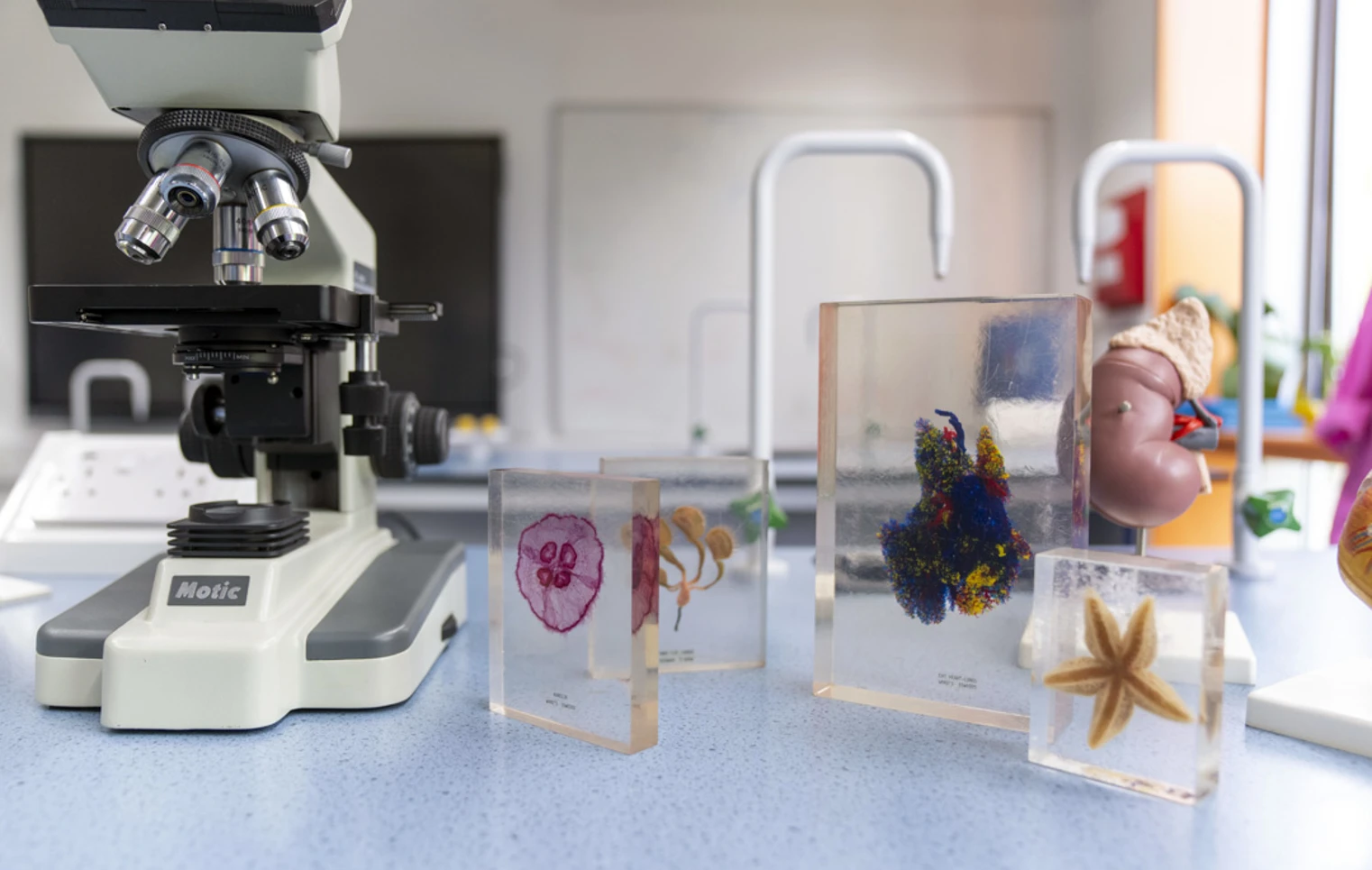
A close-up of a microscope and glass slides with preserved specimens on a science lab bench, perfect for exploring the tiny wonders of biology

About the Science Department

Science at Glasgow Kelvin College is about curiosity, discovery and understanding how the world works — brought to life through hands-on learning and real experiments and experiences. Whether you’re interested in healthcare, laboratory science or exploring different areas of science, you’ll learn by doing from day one.

From “Steps Into Science” programmes through to Access courses and HNC-level study, you can begin at the level that’s right for you and progress with confidence. Our Access courses are designed for adults returning to education and provide a supported pathway into university, even if you don’t have the qualifications to go straight there.

Through practical lab work, fieldwork and investigative projects, you’ll develop the skills, confidence and experience needed to move on to university, healthcare careers or a wide range of science-based roles.

There’s No Wrong Path 🤩👨‍🔬

Full-time work 👉 College 👉 Degree 👉 Masters 👉 PhD

Meet Glen, a former Applied Science student at Kelvin, now undertaking a PhD in blood cancer research.

From his first steps in science at college to receiving a £10,000 research grant, Glen’s journey shows where determination and the right support can take you.

Big goals. Real impact.

Science at Kelvin | Real Learning in Action 🔬🧪🌿

Discover what it’s like to study Science at Glasgow Kelvin College through hands-on experiences, real-world learning and student stories.

From Access to Medicine students preparing for careers in healthcare, to practical lab experiments with Lewis, our students develop the skills that bring science to life.

Out on campus, Izzy and Amr explore biodiversity and local wildlife, while Robert takes on a crime scene investigation — showing the wide range of pathways available in science.

From the lab to the field, science at Kelvin is all about curiosity, discovery and progression.

Real science. Real experiences. Real futures.

  • Access to Medicine student Alexander speaking during an interview in the library at Glasgow Kelvin College.
  • Science student Lewis wearing safety goggles and gloves while demonstrating lab equipment in a college laboratory.
  • Steps into Science students taking part in a biodiversity survey on campus, collecting and discussing environmental data.
  • Science student Robert wearing protective clothing and speaking into a microphone in a college laboratory.

Dialog title

Read What Our Student Said

Video Transcript – Glen: Former Student

My project is on generating a multi-targeting therapeutic antibody for multiple myeloma with the aim of hopefully treating multiple myeloma. It's currently an incurable disease.

When I was leaving high school, I didn't really know what I wanted to do and I was quite sporty growing up. So I did HNC. I was like not going to class failing quite a lot of my exams. I dropped out a month before finishing.

My dad took me into the printing factory that he worked in. While I was there I started thinking about what did I actually like at school and could I do something at uni. Because of my grades in high school, I didn't have the right ones to get into first year at uni.

I applied to Cali to do Cell and Molecular Biology, but basically got offered the HND in Applied Bioscience at Glasgow Kelvin College instead.

Good for me because I'd been out of school that long that I think if I went straight into uni I'd have struggled.

The partnership between Glasgow Kelvin College and GCU was like a big driving force for me for picking that course because it actually gave me like a kind of clear pathway into uni.

I wouldn't panic necessarily because it took me three, four years to figure out what I wanted to do.

It doesn't need to happen right away. You can go out and work or have fun, go to college for a bit and then if you find something you want to do, take it further.

Video Transcript – Alexander: Access Medical Studies and Allied Health

I'm Alex, I'm on Access Medical Studies at Glasgow Kelvin. I chose this course to try and just get a change of career.

Prior to starting this course, I'm actually in my second year, I was on pre-medical studies. Prior to this, I was in the army for eight years. I had enough of that and thought, bit of a career change. Access course, it's under SWAP, so it's a Scottish Widening Access programme. It's designed for mature students and people returning to education. It's great, especially for someone like myself. I left school with no qualifications. I thought I was rubbish at education.

To be given the opportunity to come back, it's a chance that a lot of people don't really get. I really rate it. I think Swap's really good. And if anyone's even thinking about going back to education, look at Swap courses. The way I see it personally is it's a chance to rectify any mistakes I made. I kind of realised, right, I can now, I've got the chance to make this up. So the fact that I'm able to come back to college and potentially, or the course of my life essentially, is an opportunity in itself.

The kind of subjects you'll do is biology, chemistry, maths, English. Because it's an access course it's a bit more, that's part of the challenge when it's all together and you're constantly learning it all.

During the course there's also labs of practical elements, it's not all just sitting, writing the textbooks, you're doing experiments, you're doing labs, you're doing dissections, chemistry experiments where you're mixing different chemicals, it is really good.

Plans after this course, I've applied for uni, hopefully get into uni, so dentistry at Glasgow or Dundee, one of the two, and then that'll be a five-year degree, enjoy that, and move on from there, hopefully get a job as a dentist.

On the financial aspect, I know money can be difficult, but to put it in perspective, I've got a mortgage, I've got a house, I've got a car, I've got all these things and I still manage to make college work with all the support that college offers, it's feasible. Don't shoot it down, look into it first. If you've worked it all out, get an application and go for it.

Video Transcript – Lewis: NQ Steps Into Science

I'm ready to see some magic.

Hi, I'm Lewis. I'm on the Steps into Science level five course.

We're doing the effect of temperature change on reaction rate.

We're adding five centimeters cubed of sulfuric acid. Now we're adding two centimeters cubed of potassium permanganate and 40 centimeters cubed of water.

We're going to be lighting the Bunsen burner. We have to make sure that the hole is closed on it so that we don't get a blue flame.

We're currently heating this to about 40 degrees. Once that's at 40 degrees, we can take it off and add our oxalic acid. Once we've stirred it, it should turn colourless. That's when we can kind of judge the rate of reaction.

Chemistry is the best.

Now that we've heated this to 40 degrees, we're just moving this onto here so we can add our carboxylic acid.

Oh, here we go. So from that we can understand that it takes 1 minute and 18 for its turn colourless, which at 40 degrees is the rate of reaction.

So now we're going to repeat at 50, 60 and 70 degrees.

While we're waiting, what is the best Taylor Swift song been?

Right. I think we can cut the video later. 55 seconds. So at 50 degrees, it's a lot faster at 55 seconds.

60. Oh that was way faster third one done 17 seconds at 60 degrees this shows that as the temperature rises the rate of reaction speeds up I really see some magic

This is taking forever. 7.91 seconds. 70 degrees. It's the fastest of all. It's 7.91 seconds, which again just proves as the temperature goes up, so does the rate of reaction.

This has been a science experiment brought to you by me.

Video Transcript – Izzy and Amir: NQ Steps Into Science

Izzy: Hiya, I'm Izzy. I'm doing level five steps into science. 

Amir: Hi, my name is Amir. We're doing a survey day around the college.

Izzy: We're doing different kinds of plants in the area, species of insects and birds. Currently, we're not finding that many, we have found evidence of bird nests. Unfortunately, the birds are hiding at the moment. I think because of the weather, it's a bit rainy. 

Over here, we found a bird nest. We're not quite sure what kind of bird it is. It is up in the tree.

Unnamed student:  Surveying insects, so with these nets we're trying to find small ones, like we've seen a worm there, little spiders and that, trying to find and identify different type of insects.

Izzy: This groups is doing plants, and we've been trying to find different species of plants around the college, identifying trees and bushes.

This is the app we've been using to discover different species around the college, it's called iNaturalist. As you can see, we just take a photo and the app will tell you what it is.

Thank you for joining us on some different species around the college.

Amir: Thank you.

Video Transcript – Robert: NQ Steps Into Science

Hi, I'm Robert. I'm doing the NQ Level 6 Steps Into Science course.

Part of our course is forensics.

So we've got a wee crime scene here that we need to kind of solve, figure out who did it, how they did it.

As you can see, there's tons of money on the floor, hammer, some blood.

You can also see all sorts of chemicals that have been made.

After college, I'm planning on going to Stirling Uni to do an environmental science course.

It's a great way to get to where you want to go.

There's always more than one way to get to where you want to go.

`